
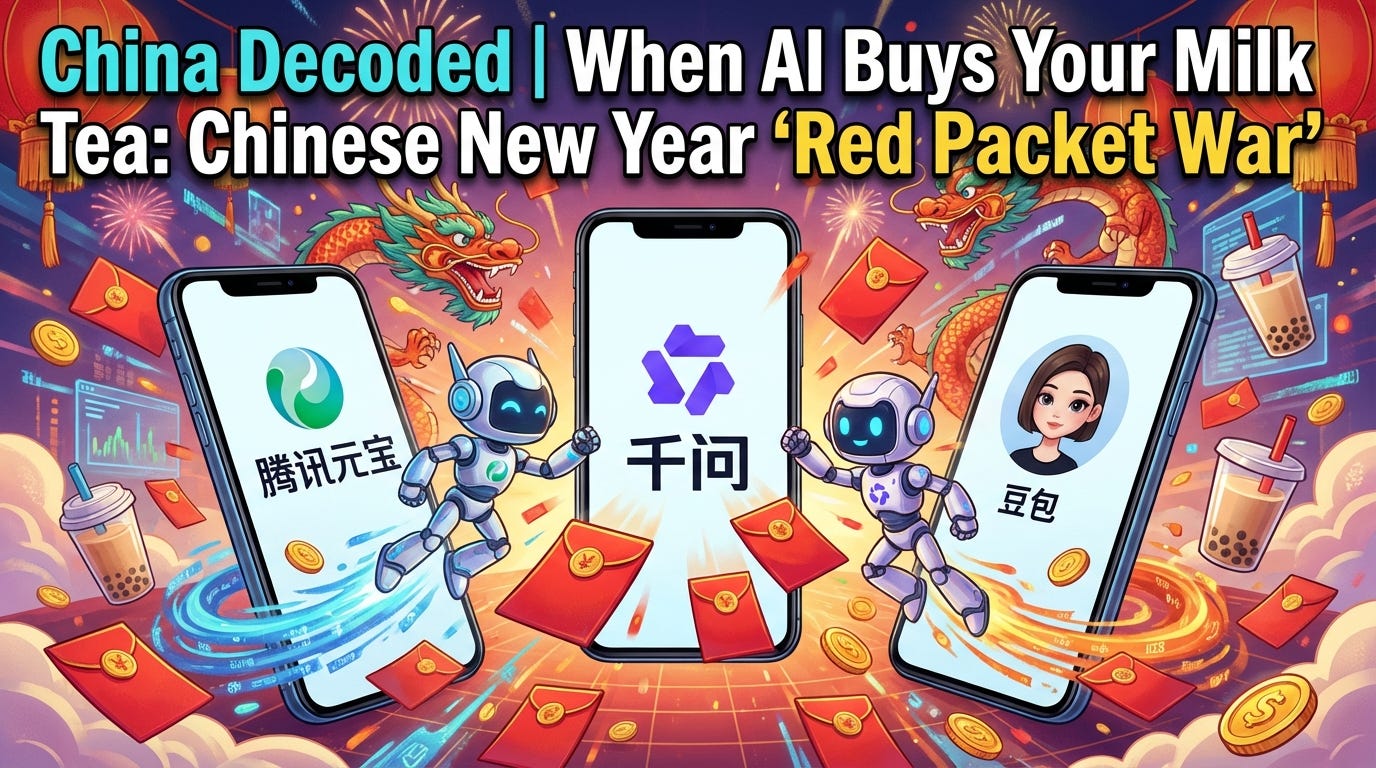
1. The New Red Packet War: Qwen, Yuanbao, Doubao
This Chinese New Year, China’s internet didn’t just revive the old “payments red packet war” – it rebooted it for the AI era. Instead of coupons buried in apps, people opened their phones and watched AI models pay for breakfast, milk tea and late‑night snacks.
Three players dominated the battlefield:
Alibaba’s Qwen: The milk‑tea avalanche
Alibaba’s Qwen app launched a “30‑billion‑yuan mega free‑order” campaign: users typed one sentence to ask the AI to order milk tea, snacks, or takeout, and the bill was wiped. Within three hours, Qianwen processed over 1 million milk‑tea orders; an hour later that number doubled, and some stores in major cities flipped to “closed” simply because they were overwhelmed. Crucially, Qianwen was not acting alone. It was wired directly into Taobao, Feizhu, Freshippo and Alipay, turning the AI assistant into an entry point to Alibaba’s entire commerce ecosystem rather than a standalone app.Tencent’s Yuanbao: WeChat social graph + 1 billion yuan
Tencent’s Yuanbao announced a 1‑billion‑yuan New Year cash giveaway: users logged in to grab cash, completed tasks to enter draws, and could win big‑ticket rewards such as “Pony Cards” worth up to 10,000 yuan. The mechanics were built around sharing to WeChat and QQ contacts to maximise viral spread. Once the campaign kicked off, Yuanbao shot to the top of the free‑app chart in Apple’s App Store in China, at one point overtaking ByteDance’s Doubao. Yuanbao’s core asset is WeChat. By embedding AI assistants into the WeChat ecosystem and leaning on the social graph for retention and conversion, Tencent is playing to its most durable advantage.ByteDance’s Doubao: Grabbing the Spring Festival Gala stage
Doubao, ByteDance’s general‑purpose AI assistant, chose a different route: on 10 February, it was announced as part of the tech stack behind China Central Television’s Spring Festival Gala, with ByteDance’s Volcano Engine serving as the show’s exclusive AI cloud partner. During the Gala and the holiday window, Doubao gave out over 100,000 “tech red packets” – robots, drones, smart devices – plus cash rewards, directly tying “AI red packets” to hardware‑driven tech consumption.
If the last generation of red packet wars pitted Alipay against WeChat Pay, 2026’s version is the first time Qwen (Alibaba), Yuanbao (Tencent) and Doubao (ByteDance) have collided explicitly as AI platforms.
2. Why Spend This Much? It’s Not About Milk Tea
On the surface, this looks like a classic “big tech burning cash for user growth” story. In reality, it is a coordinated – and very expensive – crash course in turning AI models into national‑scale consumer products.
They’re fighting for the “first AI touchpoint”
Chinese media has framed this as a battle for the “new AI traffic gateway”: whoever wins mindshare during China’s most important holiday has a better shot at becoming the default assistant for everyday tasks – search, shopping, food delivery, travel and payments. This is less about pure downloads and more about answering a strategic question: when a Chinese user has a problem in three years’ time, which AI do they instinctively open first?Subsidies crush the “try it once” barrier
For non‑technical users, generative AI has mostly been a buzzword. With Qianwen wiping bills, Yuanbao sending cash, and Doubao giving away gadgets, people are experiencing a direct, tangible loop: say one sentence to an AI, something real happens in the physical world – and it benefits you.
That is a much stronger form of onboarding than a generic “try our chatbot” campaign.Massive real‑world data to train on
The campaigns are generating interactions at extraordinary scale: millions of orders, hundreds of millions of prompts, tied to time, location, preferences, and success/failure patterns.
For the model builders, this is not just marketing. It amounts to a nationwide A/B test and stress‑test of multi‑modal models across ordering, recommendations, natural language understanding and error handling.Filtering for users who stay when the subsidies vanish
Industry estimates put the total subsidy envelope for this year’s “AI red packet war” in the 4–5 billion yuan range, but capital has become more cautious since the first wave of “model hype.”
What really matters for valuations is what remains after the party: retention, daily active users, average time spent, and the ability to convert AI usage into e‑commerce, advertising and B2B service revenue.
Seen that way, the frenzy around free drinks and cash is an expensive but deliberate “national onboarding exercise” for AI – and a data‑rich stress test for the underlying business models.
3. Domestic vs Global: Two Diverging AI Playbooks
This New Year’s battle also crystallises how China’s AI trajectory is diverging from the US‑led model.
At home: from “big models” to “everyday infrastructure”
China’s large‑model market is expected to exceed 70 billion yuan in 2026, with a three‑year compound growth rate above 40%. More than 80,000 enterprises are already deploying models, with that figure forecast to pass 100,000 this year.
The key takeaway from the holiday campaigns is that Chinese tech giants are focused on burying AI inside concrete services: e‑commerce, food delivery, local services, mobility, and even public services.
The narrative is less about “frontier science” and more about: can AI actually do something useful inside the apps people already live in?Abroad: “model + API” and enterprise SaaS first
The US‑centric ecosystem still emphasises the “model + plugins/API” approach: OpenAI, Anthropic and others provide general‑purpose capabilities, and third‑party developers build applications and SaaS products on top. Consumer assistants exist, but they are not tightly coupled with a national payments rail, commerce platform, or super‑app in the way WeChat, Taobao or Douyin are in China.
In short:China is pushing a “super‑app‑embodied AI” paradigm.
The US is leaning into an “AI as the new cloud layer” paradigm.
Strengths and gaps: strong at home, weaker globally
In Chinese‑language understanding, long‑form content, commerce recommendations and local‑services orchestration, top Chinese models can already stand alongside global leaders – and in some conversion metrics they are stronger because they are tightly integrated with transactions.
But on frontier research, truly general foundational models, and building a global developer ecosystem, China still lags the US bloc. That gap shows up in API usage patterns, open‑source community activity, and where global startups choose to build first.
A crude but useful mental model:
China is building an “AI‑powered version of China Internet 2.0”, anchored in domestic demand and dense application scenarios.
The US is building an “AI‑powered version of Cloud 2.0”, anchored in exporting infrastructure and tools globally.
Those two strategies will inevitably collide in overseas markets and in the standards battles ahead.
