
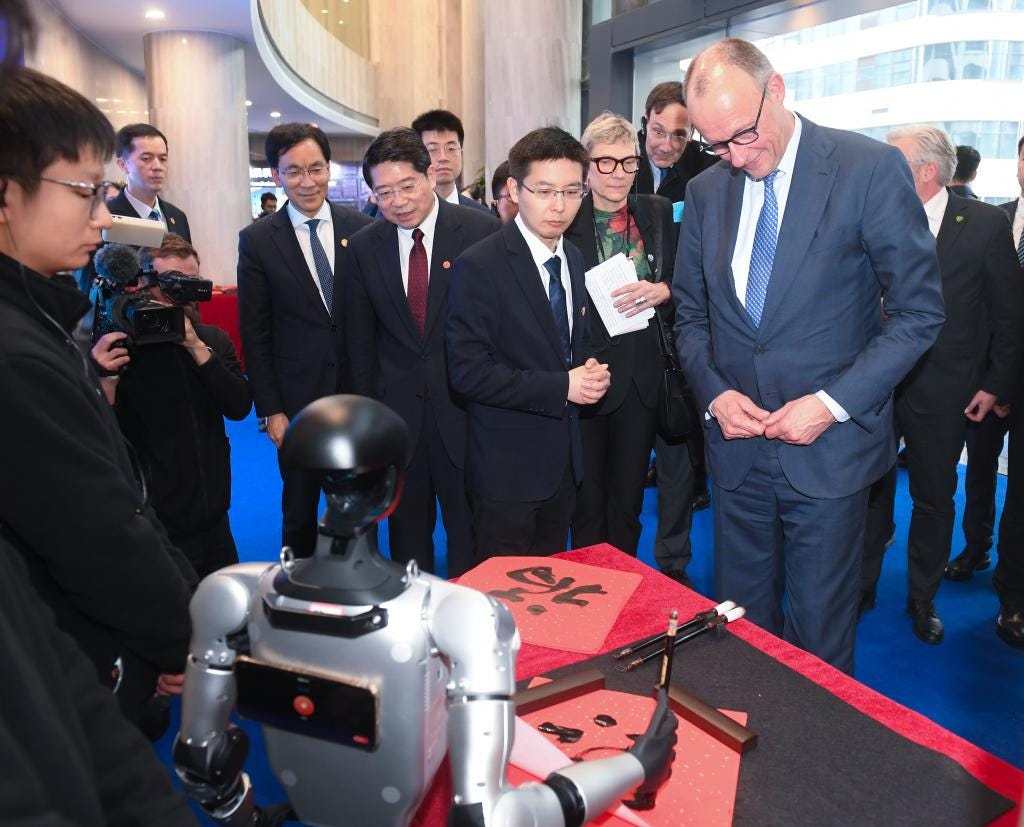
On an afternoon in late February 2026, light and shadow swept across a humanoid robot codenamed “G1” in the laboratory of Unitree Robotics in East China’s Hangzhou. Steady-handed, it picked up a brush and wrote a vigorous Chinese character — “福” (Fu, meaning “good fortune”) — on a piece of red paper.
German Chancellor Friedrich Merz bent down to take a closer look. The scene was rich in symbolism: more than 30 years ago, German experts came to China with blueprints and Siemens machine tools, teaching local factories how to achieve precision manufacturing. Today, the German chancellor has come in person, seeking a new support point for German industry at the intersection of artificial intelligence and humanoid robotics.
This subtle shift in vantage point reflects a profound adjustment in Berlin’s China policy. If the defining theme of the Olaf Scholz era was the defensively framed notion of “de-risking,” then Merz’s first visit to China in the Year of the Horse signals that Germany is moving into a more hard‑headed, realist phase — a phase of “re-calibration.”
Farewell to the “De-risking” Illusion
When the idea of “de-risking” first emerged, it was seen as a way for Europe to maintain a “middle ground” and save face amid the strategic rivalry between China and the United States. But as a new wave of tariffs rolls in with the “Trump 2.0” era, Berlin has gradually come to realize that if it were to sever its ties with the world’s largest market, German industry would not truly “de-risk.” Instead, stripped of scale effects and innovation sources, it would face the risk of functional decline.
Merz’s itinerary in China — from Hangzhou to Beijing — is a concrete enactment of this “re-calibration.” “Calibration” here no longer means simply reducing dependence, but achieving a defensive form of symbiosis through “deep embedding.” His appearance at Siemens Energy’s plant in Hangzhou sent a clear signal: rather than pacing anxiously outside the walls, Germany would do better to become an indispensable technological node in China’s forthcoming “15th Five-Year Plan.”
Xi Jinping’s “Three Points” and Strategic Steadiness
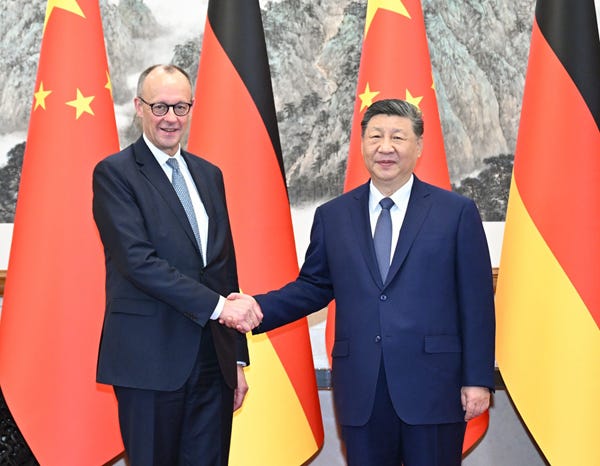
At the Diaoyutai State Guesthouse in Beijing, Chinese President Xi Jinping put forward “three points” to Merz, providing a Chinese frame of reference for this “re-calibration” of China–Germany relations.
Reliable partners: Against the backdrop of growing skepticism in Washington toward the multilateral trading system, Beijing has stressed “mutual support,” hoping Germany will continue to play the role of a stable “guardian of order.”
Innovation partners: This cuts right to Germany’s sore spot. Whether it is BMW integrating DeepSeek’s reasoning capabilities, or Siemens joining hands with Shanghai Electric to advance the green and digital transformation of power grids, China and Germany are trying to build a new industrial standard of “German precision plus Chinese algorithms.”
People-to-people partners: This is aimed at repairing the social and cognitive rifts widened by ideological narratives.
Embedded within these “three points” is a core logic: in a geopolitical landscape marked by overlapping turbulence, the stability of China–Germany ties is itself a strategic asset that can hedge against external uncertainties.
Joint Statement: Growing Up in Competition
The “China–Germany Joint News Statement” issued during the visit charted the course for this round of policy re-calibration.
First, the statement defines bilateral ties as an “all-around strategic partnership,” emphasizing that their economic and trade relations should be long-term, balanced, reliable, and sustainable. For Germany, this is a defensive framework designed to buffer the shocks of Trump-style unilateralism.
Second, the two sides explicitly wrote their respective concerns into the joint document, no longer sidestepping problems in the relationship. In other words, China–Germany ties are entering a more mature stage in which competition and cooperation co-exist: the goal is no longer to avoid friction, but to “manage competition” through institutionalized consultation mechanisms.
“German Hardware, Chinese Soul”
