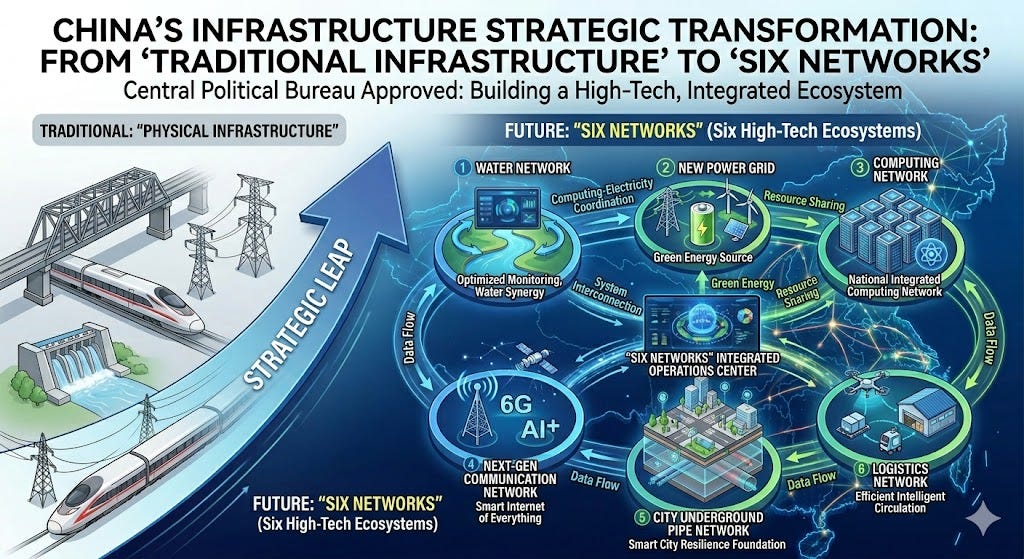
China Decoded: Inside the “Six-Network” Mega-Project
The Big Picture: China’s $1 Trillion Infrastructure Pivot
The CPC’s Central Political Bureau has greenlit a strategic overhaul of China’s backbone, transitioning from traditional “bricks and mortar” to a high-tech, integrated ecosystem known as the “Six Networks” (六张网). “加强水网、新型电网、算力网、新一代通信网、城市地下管网、物流网等规划建设。推动条件成熟的重大工程项目开工。”
According to China’s state media, Economic Daily (经济日报), with an estimated 7 trillion yuan (approx. $1 trillion) in total investment flowing through 2026, this isn’t just a stimulus package—it is the construction of a “strategic floor” for the next decade of digital and green growth.
1. The Strategy Breakdown
The Context: Why Now?
China is moving away from the old “Iron, Work, Base” (Rail, Road, Infrastructure) model. Traditional infrastructure yields diminishing returns. The “Six Networks” aim to solve three critical bottlenecks:
Energy Imbalance: Moving green power from the West to the industrial East.
Data Bottlenecks: Providing the massive compute power required for the “AI+” national initiative.
Urban Fragility: Fixing aging underground systems that cause floods and gas leaks.
2. Business Implications & The “Strategic Floor”
The Meaning for the Global Market
For international observers, the “Six Networks” represent China’s transition to Systemic Efficiency. By lowering the cost of electricity (Power Network), data (Compute Network), and movement (Logistics Network), China is attempting to maintain its manufacturing edge despite rising labor costs.
3. Opportunities for Overseas Companies
While these networks are state-led, the sheer scale of the 7-trillion-yuan rollout creates specific “entry points” for foreign expertise:
Precision Engineering & Material Science:
The “Urban Pipe Network” requires advanced, non-invasive repair materials and high-durability sensors where European and Japanese firms still hold a technological lead.
Green-Tech Financial Services:
The shift toward Infrastructure REITs and “Green Finance” opens doors for global asset managers and ESG consultants to structure the financing of energy storage and water conservancy projects.
Industrial AI & Software:
As the “Computing Power Network” matures, the demand shifts from hardware to Application Software. Overseas SaaS providers specializing in smart grid management, hydrologic modeling, and logistics optimization will find a massive, standardized “data floor” to plug into.
Low-Altitude Economy Partners:
With the “Next-Gen Comms” network providing the sky-grid, there is a burgeoning market for international aerospace components, safety certification services, and unmanned traffic management (UTM) systems.
China Decoded Insight: The “Six Networks” are the physical embodiment of “New Quality Productive Forces.” For foreign firms, the opportunity lies less in building the “pipes” and more in providing the high-end technology and financial instruments that make those pipes “smart.”


The compute network is the piece that matters most for the AI geopolitics story. If China builds a national grid that makes existing compute more efficient through pooling and orchestration, the effective impact of US chip export controls diminishes without China needing to match TSMC node for node. You solve the constraint at the systems layer rather than at the silicon layer.
Worth noting the timing too. This is $1 trillion of state-directed capital flowing into productive infrastructure at exactly the moment the property sector can no longer absorb it. The old playbook was roads and apartments. The new one is compute, power transmission, and logistics. Same fiscal mechanics, very different output. Whether it works depends on whether the demand side materialises, but as a capital redirection exercise the logic is sound.
The US and China are now racing toward the same infrastructure layer through completely different capital structures. Private hyperscaler capex in the US, state-directed investment in China. Both building power grids, compute networks, and logistics systems. The question is which model builds faster and which builds more resiliently. That race will probably matter more than the chip war itself over the next decade.