
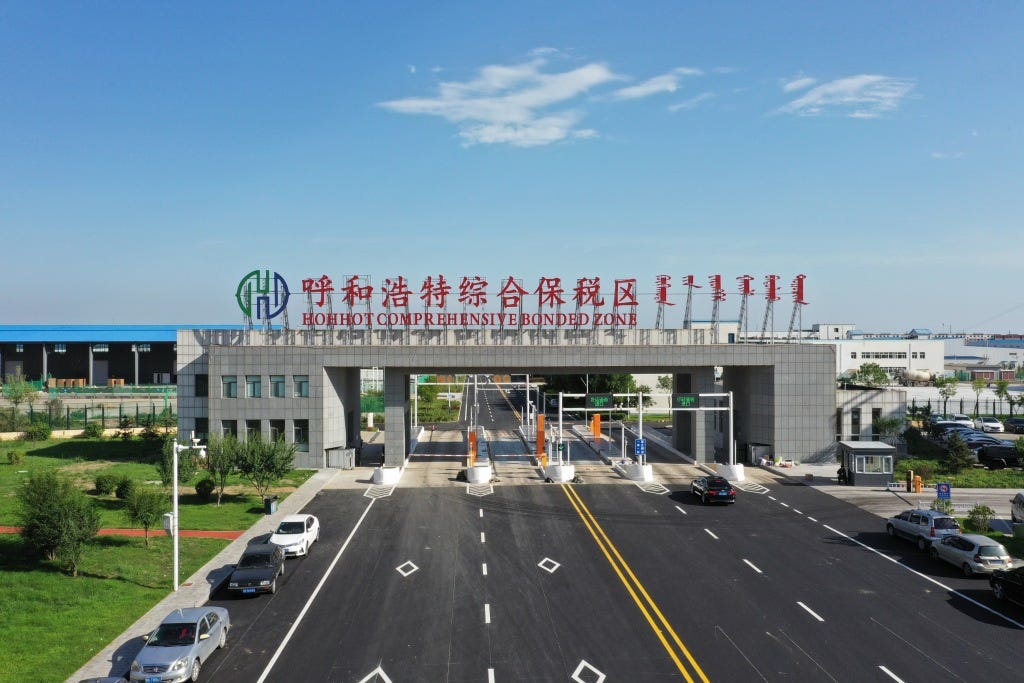
I. Headlines: Inner Mongolia Pilot FTZ Officially Unveiled
On April 11, 2026, the China (Inner Mongolia) Pilot Free Trade Zone was officially inaugurated, marking a pivotal shift in China’s “Northward Opening” strategy.
Background: Spanning 119.74 square kilometers, the FTZ is divided into three strategic areas: Hohhot (the capital hub), Manzhouli (the Russian border gate), and Erenhot (the Mongolian border gate).
The Blueprint: The zone aims to transform Inner Mongolia from a “pass-through” logistics corridor into a high-value industrial powerhouse. It focuses on integrating “New Quality Productive Forces” with traditional border trade.
Significance: It serves as the final “missing piece” in China’s national FTZ layout. By connecting the China-Mongolia-Russia Economic Corridor, it creates a land-based alternative to maritime trade, securing national energy, food, and computing resource chains.
II. Global Opportunities: Who Stands to Gain?
The establishment of this FTZ opens specific “green channels” for international stakeholders, particularly in sectors previously restricted.
1. Target Countries & Regions
Russia & Mongolia: Deepening integration in minerals, livestock, and cross-border payment systems.
Central Asia & Europe: Enhanced efficiency for China-Europe Railway Express “customized trains.”
Belt & Road Partners: Opportunities in joint laboratory research and agricultural technology transfer.
2. Strategic Industries & Foreign Investment Access
III. Tech Deep-Dive: “East-to-West Computing” & the AI Engine
The most forward-looking aspect of the Inner Mongolia FTZ is its designation as a Green Computing Power Hub for China’s AI industry.
What is “East-to-West Computing”?
Similar to “South-to-North Water Diversion,” this national strategy moves data processing from China’s overcrowded eastern megacities (Beijing, Shanghai) to the energy-rich west.
Why Inner Mongolia?
The “Green” Edge: Inner Mongolia possesses China’s most abundant wind and solar resources. AI training is energy-intensive; the FTZ allows AI firms to utilize low-cost, carbon-neutral “Green Power.”
Climate & Proximity: The naturally cold climate reduces cooling costs for massive data centers (Lower PUE). Its proximity to Beijing ensures low latency (under 10ms), making it the “Back-end Brain” for the capital’s tech giants.
