
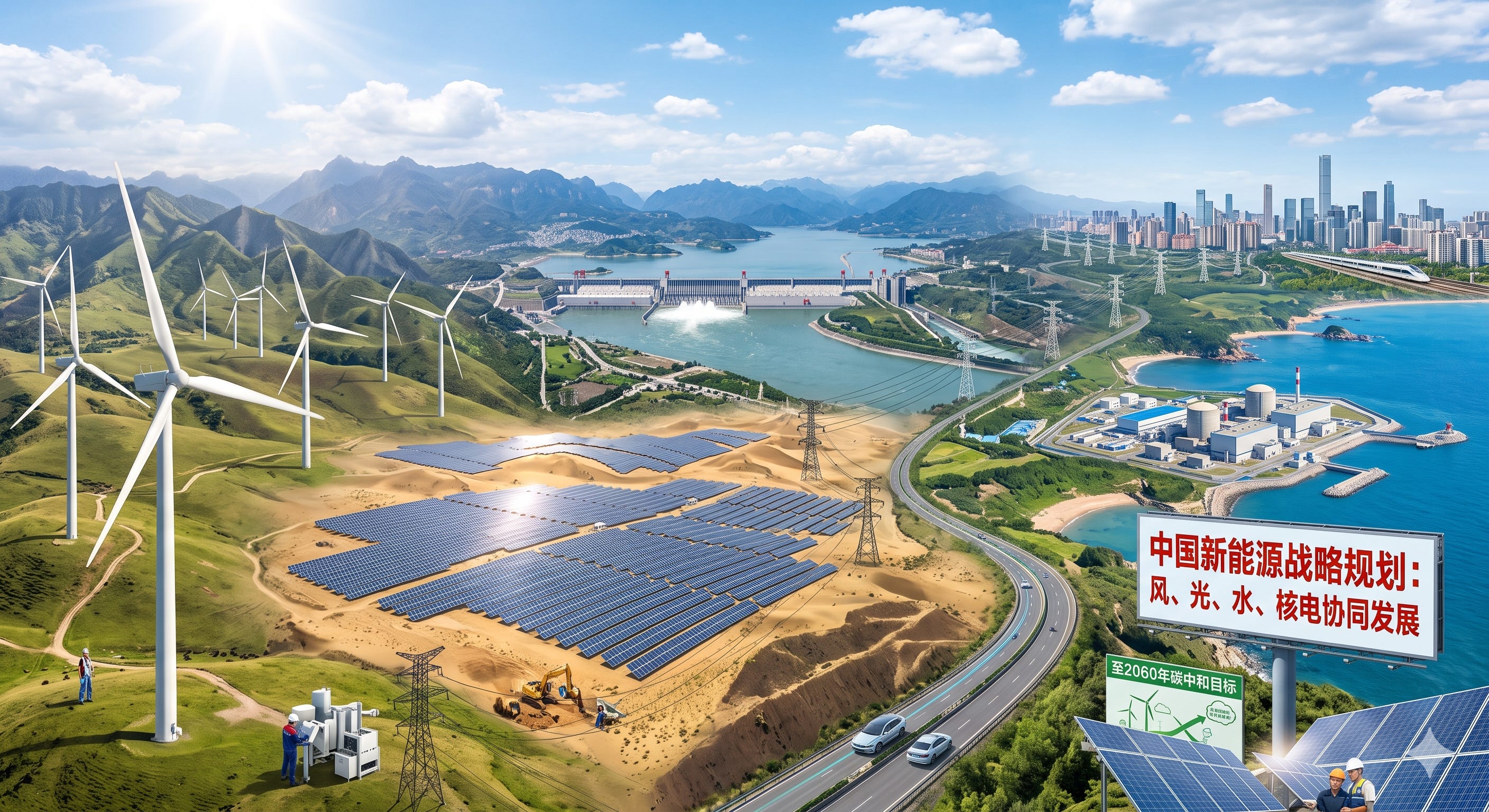
China’s new plan for building a “new‑type energy system” was jointly issued on June 25, 2026 by the National Development and Reform Commission (NDRC) and the National Energy Administration (NEA). It is a sectoral plan under the 15th Five‑Year Plan, covering the period 2026–2030 and spelling out how Beijing wants to re‑engineer its energy system by 2030.
The document aims to “basically establish a clean, low‑carbon, secure and efficient new energy system” by the end of the decade, aligning energy policy with China’s broader goals on energy security and its carbon peaking and neutrality pledges. It sets quantitative targets for non‑fossil energy, electrification, system flexibility, innovation and market reform, and was introduced to the public at a State Council Information Office press conference on June 26, signalling that this is not just a technocratic roadmap but a political priority for the coming five years.
Key Targets in China’s New Energy System Plan
China’s new plan for building a “new-type energy system” under the 15th Five-Year Plan is not just another climate document; it is a system design blueprint that hard‑codes what the country’s power system should look like by 2030.
A Bigger, More Electric Energy System
By 2030, China aims to “basically build” a clean, low‑carbon, safe and efficient new energy system. Total energy production capacity is set to rise from 5.13 to 5.8 billion tonnes of coal equivalent, while total installed power capacity climbs from 3.89 to 5.4 billion kilowatts. In other words, this is a greener system that is still getting bigger, not smaller.
Electricity’s role in the economy will deepen: power is targeted to reach 35% of final energy consumption by 2030, up from 30% in 2025. This pushes China’s electrification five years ahead of the COP31 proposal for a global 35% electrification goal by 2035, and entrenches the power system as the core arena for decarbonisation.
Non‑Fossil Energy: Half the Power, Not the Whole Story
On the supply side, the plan codifies a set of non‑fossil targets that look ambitious at first glance but are in fact conservative floors rather than stretch goals. Non‑fossil energy should reach 25% of total energy consumption by 2030, essentially a continuation of China’s existing 2030 commitment rather than an upgraded pledge.
In the power sector, non‑fossil sources are expected to provide 50% of electricity generation, up from 42.3% in 2025. Wind and solar are explicitly designated as the “main body” of installed capacity, with their combined share rising above 50%, and “new energy” generation (wind and solar) is set to reach 30% of total power output. That still leaves roughly half of China’s electricity coming from fossil fuels, with coal power shifting from being a baseload workhorse to a “supporting and regulating” resource rather than exiting the system.
Carbon Intensity and System Flexibility
The plan does include a new carbon intensity target for the power sector: emissions per unit of generation must fall by more than 10% from 2025 levels by 2030. This is directionally positive, but it is framed as a carbon‑intensity goal, not an absolute cap on emissions. As the accompanying analysis you shared points out, if total generation grows by around 5% per year, a 10% cut in intensity would still allow power‑sector emissions to rise by roughly 15% over the period.
Where the plan is more concrete is on system flexibility. It introduces a new metric for “source‑storage regulating capacity” – the combined regulating capacity of generation and storage – which is required to increase by more than 40% by 2030. Demand response capacity should rise from above 3% to above 5%, and the grid must be capable of supporting 900 GW of distributed renewables by 2030. On the supply‑side flexibility toolkit, the plan calls for 160 GW of pumped hydro and 300 GW of new‑type energy storage. These signals matter for investors because they show Beijing’s focus has shifted from “how much wind and solar can we build” to “how much variable renewables can the system actually integrate”.
Electrification, AI and the “New Power System”
The plan’s picture of a “new‑type power system” is built around high electrification, strong grids and digital coordination. Large clean‑energy bases in China’s “Three North” regions and southwest hydropower corridors will be connected to load centres via new long‑distance transmission channels, while regional grids are strengthened to provide mutual support and cross‑regional balancing.
On the demand side, the plan seeks to build a flexible load ecosystem. It pushes full‑scale use of user‑side demand response, targeted development of virtual power plants, and large‑scale vehicle‑to‑grid integration, with V2G aggregated controllable charging capacity targeted at 50 GW and virtual power plant regulating capacity at 50 GW by 2030. It also explicitly embeds “AI + energy” in the system design: energy bases and national computing hubs are to be co‑planned, data centres and other new industries are encouraged to pursue green‑power direct connections, and energy and digital infrastructure are to be developed as integrated clusters.
What This Means for Western Investors
For Western investors, this plan should be read less as a climate pledge and more as a state‑designed investment platform for China’s energy transition over the next decade.
A Policy‑Guided Capex Envelope
China’s energy regulator estimates that priority energy projects and new energy‑related business models under the 15th FYP will unlock more than RMB 20 trillion in investment over 2026–2030. This estimate, disclosed at the State Council press conference, bundles three baskets of spending:
Traditional energy security – oil and gas exploration and production, strategic reserves, national pipeline networks, and modernised coal supply bases.
Green transition infrastructure – non‑fossil power bases, long‑distance transmission channels, regional grid interconnections and distribution‑level upgrades.
New business models and “new quality productive forces” – new‑type energy storage, hydrogen and green fuels, virtual power plants, comprehensive energy service stations, and AI–energy integration.
For investors, this is effectively a policy‑guided capex envelope: it tells you where the Chinese state intends to deploy both public and private capital, and which technologies it expects to become core parts of the system rather than peripheral pilots.
