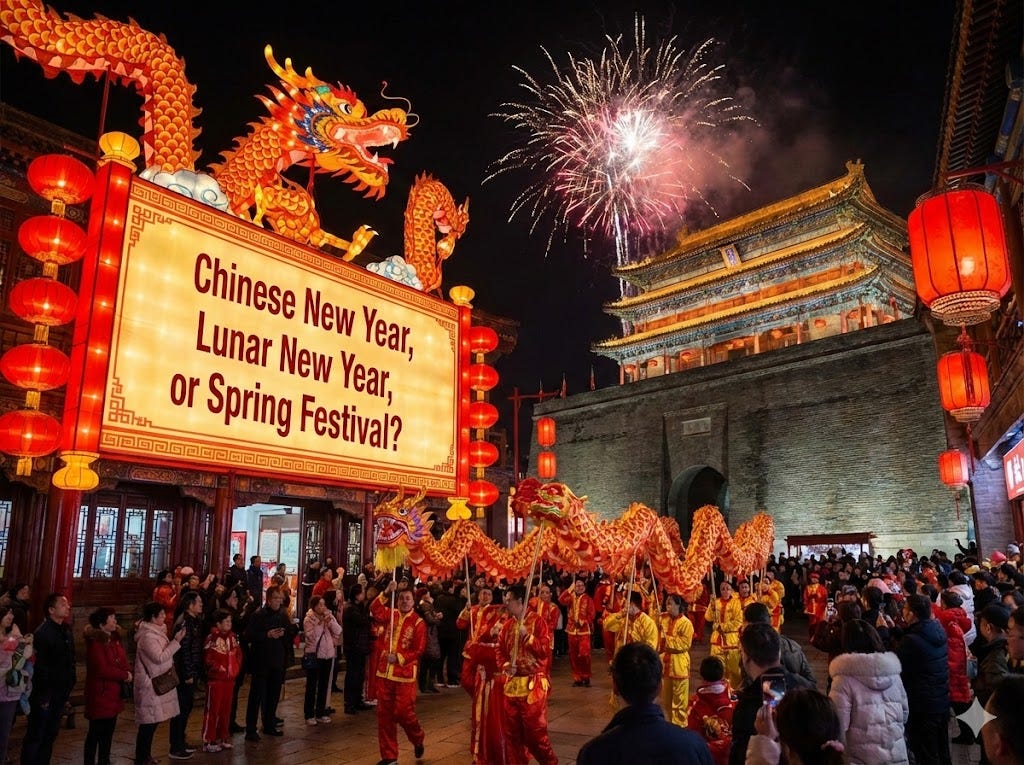
đź Chinese New Year, Lunar New Year, or Spring Festival?
Welcome to this weekâs edition of China Decoded. Every year, as late January or February rolls around, a familiar debate sparks across international media, corporate PR departments, and online forums: Should we call it Chinese New Year or Lunar New Year?
What seems like a simple question of translation actually sits at a fascinating intersection of astronomy, historical copyright, and modern multiculturalism. Letâs decode the science and the sociology behind the biggest holiday in Asia.
1. The Astronomical Flaw of âLunar New Yearâ
If we look at this strictly through the lens of science, the popular English term âLunar New Yearâ is actually a misnomer.
If the Chinese calendar were a purely lunar calendar (strictly following the moonâs phases without adjusting for the earthâs orbit around the sun)âlike the Islamic Hijri calendarâits new year would shift backward by about 11 days every year. Eventually, the festival would drift into summer, and youâd be eating hot dumplings in June!
But that never happens. Why?
The Lunisolar Reality: The traditional Chinese calendar is not a lunar calendar; it is a Lunisolar Calendar.
The Moon (The Lunar part): Dictates the months (the 1st is a new moon, the 15th is a full moon).
The Sun (The Solar part): Dictates the years and the 24 Solar Terms (guiding agriculture).
The Leap Month: To align the moonâs cycles with the solar year, ancient Chinese astronomers invented an intercalary system. Roughly every three years, a âleap monthâ (é°æ) is added.
This brilliant mathematical fix anchors the new year permanently between January 21 and February 20. It is scientifically impossible for it to drift into June. Therefore, the most scientifically accurate translation in English would be âLunisolar New Yearââbut thatâs a bit too academic for a greeting card!
2. Historical Copyright vs. Local Adaptation
If the calendar is fundamentally Chinese, shouldnât it just be called Chinese New Year?
âIf the language from England is called âEnglishâ everywhere, shouldnât the calendar invented in China be called âChinese New Yearâ?â This is a brilliant linguistic analogy. It highlights the concept of Historical Copyright. Ancient China absolutely invented the mathematical and astronomical foundation of this calendar. Using âChinese New Yearâ is entirely accurate, especially when referring to the specific cultural practices (red envelopes, dragon dances) that originated in China.
However, culture spreads differently than language. When this calendar system spread across Asia centuries ago, neighboring countries adopted the timing but completely localized the traditions.
Vietnam celebrates Táșżt with square sticky rice cakes (BĂĄnh chưng) and traditional Ăo dĂ i dresses.
South Korea celebrates Seollal by eating sliced rice cake soup (Tteokguk) to symbolize growing a year older.
To these communities, it is a deeply authentic, local holidayânot a âChineseâ one. In Western countries with diverse Asian diasporas, the term Lunar New Year was popularized as an âumbrella termâ by local governments and corporations to be inclusive of all these distinct cultures celebrating on the same day.
3. The Friction Point: Erasure vs. Appropriation
This is where the debate becomes politically charged, involving concepts of cultural erasure and appropriation.
The Fear of Erasure: For many Chinese, the aggressive push in the West to replace âChinese New Yearâ with the generic âLunar New Yearââespecially when referring to specifically Chinese customs like red couplets or lion dancesâfeels like cultural erasure (ć»äžćœć). It is seen as a deliberate attempt to de-sinicize the festival and hide its origins to make it more palatable to a Western audience.
The Avoidance of Appropriation: Conversely, insisting that a Vietnamese or Korean person is celebrating âChinese New Yearâ can be viewed as a form of cultural insensitivity, forcing their unique national traditions under a foreign banner.
This tension makes the choice of words a potential minefield in international communication.
4. The Ultimate Solution: The âSpring Festivalâ
Given that CNY can be exclusionary to other Asians, and LNY is scientifically inaccurate and offensive to some Chinese, what is the best path forward?
We recommend the most authentic, literal, and poetic translation of the modern Chinese name (æ„è): The Spring Festival.
Itâs Scientifically Sound: It honors the âsolarâ aspect of the calendar, as the date is tied to the solar term Li Chun (ç«æ„ - the Beginning of Spring).
Itâs Culturally Rich: It captures the true spirit of the holiday: bidding farewell to winter and welcoming the agricultural renewal of spring.
Itâs Neutral ground: It describes the essence of the festival without getting trapped in the âChina vs. Lunarâ political crossfire.
â Final Recommendation for our Readers
Context is everything. There is no single âcorrectâ answer, but there are smarter choices:
The Safest Bet for China Focus: When engaging specifically with Chinese counterparts or discussing Chinese traditions, use âThe Spring Festivalâ or âChinese New Year.â They are accurate and appreciated.
The Most Respectful Approach: If you know someone is Vietnamese, wish them a "Happy Táșżt." If they are Korean, "Happy Seollal." Acknowledging specific cultural identities is always the highest form of respect.


Happy Chinese New Year đ§§
Agreed, but what about those of us in the southern hemisphere, where it's not spring, but a long, humid, hot summer?
Happy Spring Festival!!