From the ‘Thucydides Trap’ to the Dao of ‘Zhonghe’: How China-US Relations Are Navigating Towards ‘Constructive Strategic Stability’
'Constructive Strategic Stability' is the term China is using to describe its goals in relations with the US following Xi Jinping's meeting with Donald Trump.
Nine years ago, covering President Xi Jinping’s visit to the United States, I stood in a makeshift workspace not far from Mar-a-Lago in Florida. Through a monitor, I watched the first handshake between the Chinese and American heads of state under the warm southern sun. At that time, the air was thick with a mixture of cautious expectation and uncertain probing. It was also in 2017 that Graham Allison, the founding dean of Harvard’s Kennedy School, published Destined for War: Can America and China Escape Thucydides’s Trap?, propelling this chilling historical prophecy to the pinnacle of global debate.
The principle of Thucydides Trap, originally based on the conflicts between Greek Sparta and its rising rival Athens, was that conflict becomes the default when an emerging power begins to challenge a dominant rival. In interviews with Professor Allison at Davos and elsewhere, he consistently emphasised a single point: while structural contradictions are inevitable, human wisdom must prevail over historical destiny.
With President Trump’s current visit to China and the establishment of a new positioning for China-US relations -‘Constructive Strategic Stability’ -the ‘Questions of History, the World, and the People’ previously posed by President Xi have finally found a clear, realist footnote. This positioning is no longer an abstract, grand vision; it is a ‘strategic contract’ forged from the realities of power dynamics and a shared consensus on survival.
How relations have evolved
The economic relationship between China and the US has long been regarded as the ‘ballast’ and ‘propeller’ of the bilateral bond. However, this ballast is undergoing a profound structural metamorphosis. In earlier decades, the trade relationship was often characterised by the phrase ‘800 million shirts for one Boeing aircraft’. This reflected the early stages of China as the ‘world’s factory’, relying on labour-intensive exports of garments and toys to exchange for American high-tech aviation.
I recall covering the early stages of the trade war in 2017 when ‘intermediate goods’ was the buzzword for understanding bilateral trade. At that time, an iPhone assembled in China featured design from California and key components from Japan and South Korea; China contributed only low-cost assembly labour. The ‘trade deficit’ debated so fiercely then often ignored the reality of global value chains, where the lion’s share of profit flowed back to American corporations.
Nine years later, as we re-examine the economic landscape between Beijing and Washington, the structure has fundamentally shifted. China has evolved from the era of ‘800 million trousers’ to a burgeoning epoch of robotics, artificial intelligence, and electric vehicles. The resulting competition is unavoidable, yet it has brought a new clarity: challenges such as AI safety, cross-border pandemics, and climate change (even if the current US administration remains sceptical) are ‘existential challenges’ that transcend national borders. These threats compel the two nations, amidst intense strategic competition, to carve out a ‘limited yet precise’ path for cooperation.
Even in the eyes of Washington’s staunchest hawks, the reality of this shift is inescapable. In recent days, the sight of US Secretary of State Marco Rubio giving a ‘thumbs up’ while gazing at the starlit ceiling of the Great Hall of the People, or the Chinese-style attire and ‘tiger-head pouch’ worn by Elon Musk’s young son, serve as micro-footnotes to this macro transformation.
A long history of interconnection
As a journalist who spent seven years stationed in the United States, I know intimately that the resilience of this relationship has never existed solely in diplomatic communiqués. At the Chinese Historical Society of America (CHSA) in San Francisco, I once stood for a long time staring at the rudimentary tools left by the Chinese labourers who built the First Transcontinental Railroad. They recorded blood, sweat, and a monumental contribution. From the Flying Tigers who fought side-by-side against fascism in WWII to the ‘Ping-Pong Diplomacy’ that thawed the icy silence, these bonds have played a role at every historical turning point.
Today, these ties are reviving in unexpected ways in the digital age. From the ‘Pickleball’ craze sweeping America to the ‘Chinaxxing’ tag trending on TikTok—where American youths share their authentic experiences of travelling in China—to US netizens singing and dancing along to the melodies of a Chinese ‘Auntie’, this bottom-up emotional exchange is deconstructing the cold narratives of politicians.
A former CNN colleague once shared a story with me about interviewing a ‘bangbang’ (porter) on the streets of Chongqing. The man, drenched in sweat, told him his greatest wish was to work hard to buy a car and send his daughter to the best school. My colleague remarked: “Isn’t that the purest form of the American Dream? The ‘Chinese Dream’ and the ‘American Dream’ are essentially the same.” The shared values of family responsibility, the pursuit of efficiency, and the belief in prosperity through hard work are deeply synchronised in the genes of both peoples. If Tsinghua University and the Peking Union Medical College are monuments to early cooperation, today’s scientists working side-by-side in labs and netizens engaging spontaneously on social media are writing the next chapters of this human connection.
The Four Stabilities
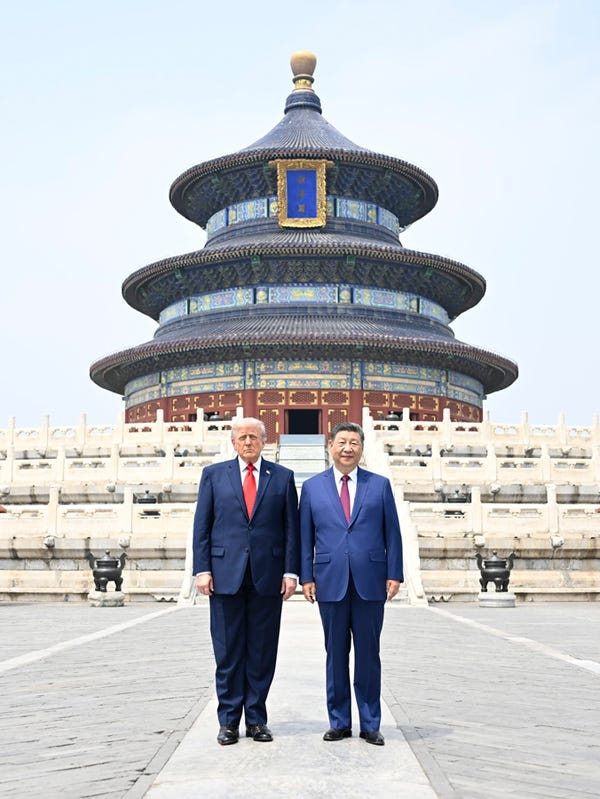
As President Trump’s motorcade swept past Beijing’s Central Axis towards the Temple of Heaven, the weight of history met the realism of modern diplomacy. The beauty of Chinese architecture is encapsulated in the concept of ‘Zhonghe’ (Centrality and Harmony). Within the red walls and blue tiles of the Temple of Heaven lies a dynamic balance—not a pursuit of absolute uniformity, but a search for coordination amidst opposites.
The newly established ‘Four Stabilities’—stability based on cooperation, healthy stability through moderated competition, routine stability through controllable differences, and enduring stability with the prospect of peace—represent a departure from earlier romanticism in favour of this ‘Zhonghe’ wisdom. This is a higher form of pragmatism. It acknowledges ‘cooperation without excluding competition,’ as competition drives efficiency; it insists on ‘peace without evading differences,’ as a mature relationship requires no feigned harmony. For too long, the West has misunderstood the Chinese concept of ‘Win-Win’ as China wanting to ‘win twice.’ The true Dao of ‘Zhonghe’ is that the world is not a zero-sum game; the vast Pacific Ocean is wide enough for two great powers to compete in their respective orbits and shake hands where they intersect.
A shared future
As the United States approaches its 250th anniversary, facing a China with five millennia of civilisational composure, both sides are learning how to manage expectations in an imperfect world. Compared to previous frameworks, ‘Constructive Strategic Stability’ is more honest: it accepts competition but rejects chaos; it acknowledges differences but pursues a lasting peace.
As President Trump noted at the state banquet, the American founding fathers held a profound respect for the wisdom of Confucius. Transcending the Thucydides Trap does not require the erasure of differences, but rather, like the structural integrity of the Hall of Prayer for Good Harvests, achieving steadfastness through the balanced intersection of diverse forces. The Pacific is indeed wide enough for two great nations. Seeking cooperation within competition and anchoring peace amidst differences may well be the most stable strategic dividend our generation can offer the world.

