

I. Three Must-Read Heavyweight Reports and the Question of Credibility
In the spring and summer of 2026, the fields of international communication and geopolitics welcomed three watershed reports. In April and July, Gallup and the Pew Research Center successively released their latest global polls, signaling a historic shift: global approval ratings and recognition of China’s leadership have surpassed those of the United States for the first time in both polls. Meanwhile, in June, the Digital News Report published by the Reuters Institute for the Study of Journalism at Oxford University revealed a parallel trend: the global news ecosystem is undergoing an unprecedented structural transformation. Audiences are increasingly turning to social media, video networks, and newly emerging Artificial Intelligence (AI) for information, leaving traditional broadcast television behind.
What changes do these phenomena reflect? Are they connected? For a long-time observer of international news and communication like myself, these three reports are absolute must-reads this year, and the underlying causes demand a deep dive.
The persuasiveness of any poll largely depends on the scientific rigor of its methodology and the representativeness of its sample. Driven by the professional habits of a media worker, my first instinct is always to click the methodology links and scrutinize the details:
Gallup provided an exhaustive 242-page methodology detailing a sample spanning nearly two decades and covering over 130 countries.
Pew’s methodology this year was over 30 pages long, accurately detailing cross-sections of race, gender, education, birthplace, partisanship, and political leanings.
Such meticulous disclosure provides a clear understanding of the data collection process, significantly cementing its credibility.
As for the Reuters Institute’s Digital News Report, I have a much more personal connection to it. In June 2023, I was at the Reuters headquarters in London’s Canary Wharf attending the launch of that year’s report. The lead author at the time was Nic Newman. I remember having a detailed conversation with him about the methodology, suggesting they include samples from more countries and regions, and conduct a more granular analysis of different media environments to better capture media characteristics across diverse cultural backgrounds. Today, the project is headed by Jim Egan, a veteran with extensive experience at the BBC and the Financial Times, and the report’s scope has grown even broader.
II. A Historic Reversal in Polling Data and the Deep Restructuring of the Media Landscape
If you carefully study the Gallup and Pew data, you will find that the shift in the international images of the US and China is not a minor fluctuation, but rather a structural displacement spanning multiple global regions, encompassing both US allies and the Global South.
1. A Comprehensive Data Crossover and Reversal
Gallup’s survey across more than 130 countries showed that in 2025, the global median approval rating for China’s leadership rose to 36%, while the US plummeted to 31%. China’s 5-percentage-point lead is the widest gap Gallup has recorded in nearly 20 years.
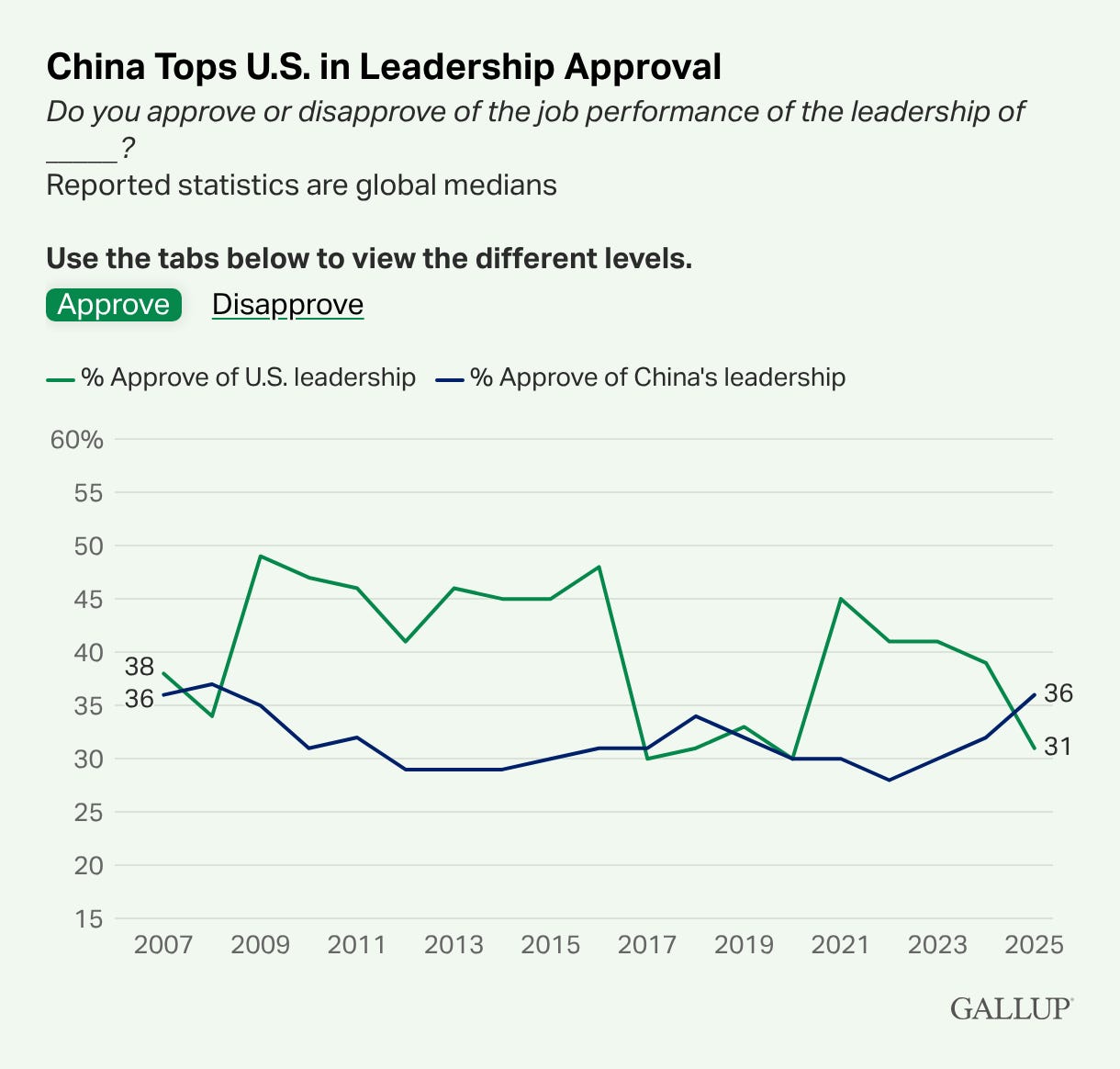
Even more noteworthy is the shift in “disapproval” ratings: global disapproval of US leadership soared to a record high of 48%, while China’s disapproval rating remained stable at 37%. The US saw its approval rating drop by 10 percentage points or more in 44 countries, with the most severe declines occurring among its traditional Western allies:
Germany’s approval of US leadership plummeted by 39 percentage points.
Portugal dropped by 38 points.
Canada, the UK, and Italy also experienced drastic double-digit declines.
Among NATO allies, the median approval rating across 31 countries fell by 14 points.
Pew’s in-depth survey of 36 countries further corroborates this trend. In a striking turn of events, America’s land neighbors, Canada and Mexico, both flipped—in Canada, 44% of respondents now hold a favorable view of China, compared to just 33% for the US. Across the 36 countries, the US maintains a favorability lead in only six, including Japan, South Korea, the Philippines, and India.
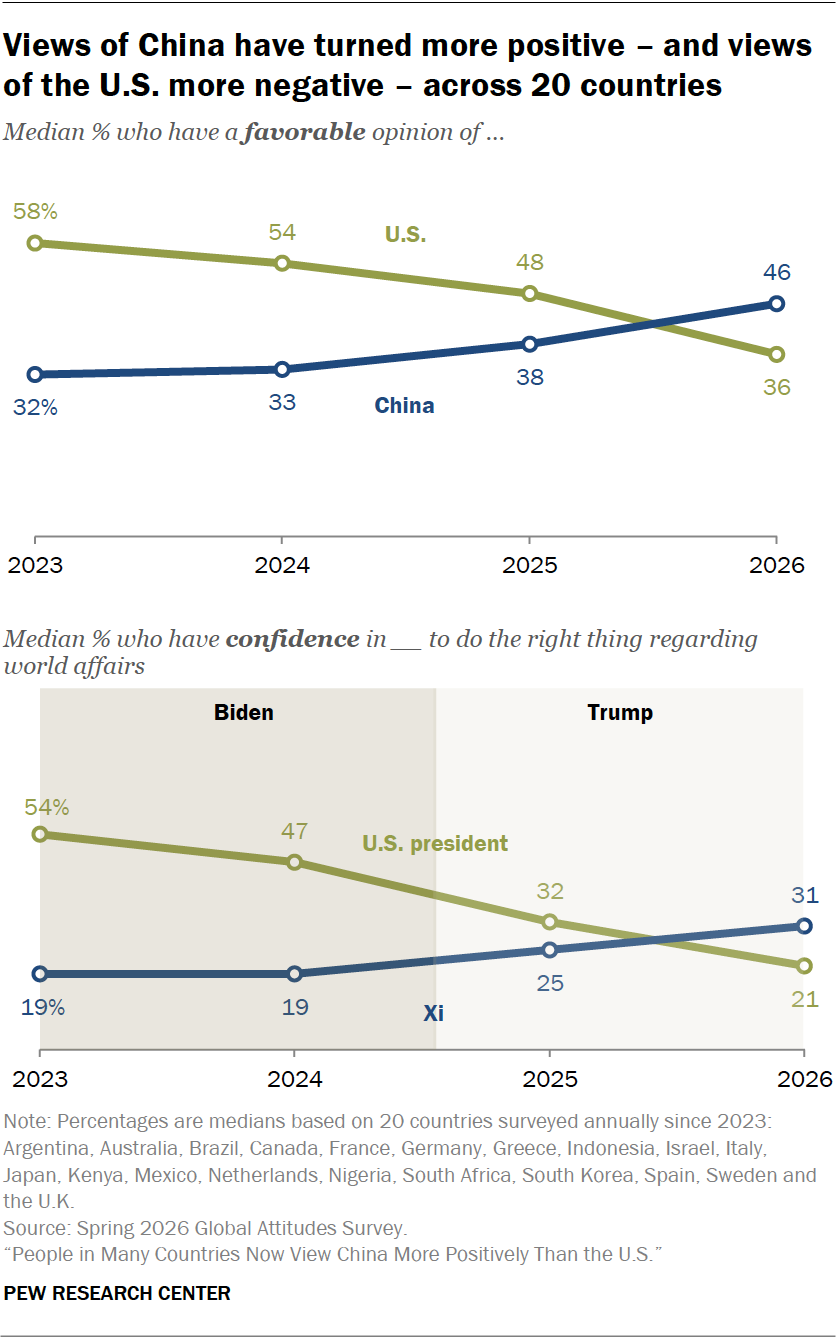
Regarding personal trust in leaders, confidence in the Chinese leader leads Donald Trump by double digits in major European nations like Germany, the UK, Spain, Italy, and the Netherlands. Furthermore, in a traditional area of Western advantage—”respect for the personal freedoms of its people”—the percentage of respondents in Sweden, Canada, France, and Germany who believe the US government respects personal freedoms has plummeted by over 25 percentage points since 2021. Meanwhile, in middle-income and Global South countries, 75% of respondents believe the US overly interferes in other countries’ affairs. In nations like South Africa, 72% view China as a reliable partner, far exceeding the 46% who say the same of the US.
