
Date: February 16, 2026
The 62nd Munich Security Conference (MSC) has concluded not with a consensus, but with a palpable sense of dread. The flagship report, aptly titled “Under Destruction,” captures a world where the old guardrails are being systematically dismantled. But the real story wasn’t just in the printed reports—it was in the visceral, sometimes jarring, exchanges on the floor that signaled a profound shift in how the world’s powers view their survival.
The “Munich Moment”: Wang Yi’s Gamble on Historical Memory
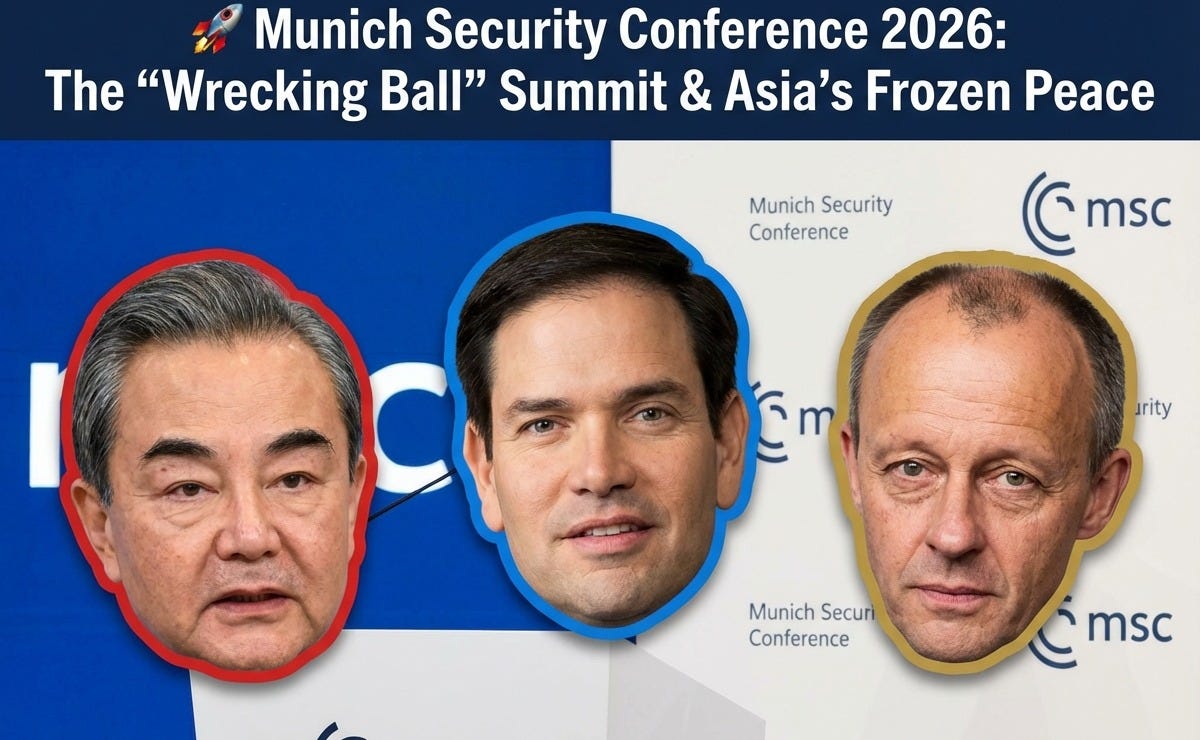
The defining moment of the conference came during Chinese Foreign Minister Wang Yi’s session. It was a masterclass in “Bottom-line Diplomacy,” but delivered with a sharpness that left some diplomats unsettled.
The crux of the tension lies in Tokyo’s recent strategic pivot. The Takaichi administration in Japan has been increasingly vocal about its “survivability” in a Taiwan conflict, effectively linking the security of the Taiwan Strait to Japan’s own sovereign defense. Wang Yi didn’t just rebut this; he weaponized the venue itself. Standing on German soil—a nation that has spent eighty years performing the arduous work of historical “liquidation”—Wang drew a stinging parallel. He lauded Germany for its moral clarity while accusing Japan of harboring “unabandoned colonial ambitions” and allowing the “ghost of militarism” to dictate its modern defense posture.
His warning was devoid of typical diplomatic ambiguity: “If Japan seeks to gamble once more, it will face a swifter defeat and a more disastrous loss.” This was a calculated move to frame Japan as the “Revisionist Power” in the eyes of the West, using the memory of World War II to invalidate Japan’s current push for security “normalization.”
A House Divided: The Transactional West
While Beijing was drawing red lines in Asia, the “Western” front showed deep fissures. The discourse from Washington has shifted from “leadership” to “leverage.”
Secretary of State Marco Rubio’s presence in Munich was less about reassuring allies and more about setting the terms of a new, transactional contract. The message to Berlin and Paris was clear: the American security umbrella is no longer a public good—it is a conditional service. This has forced Germany into a state of “Anxious Realism.” Chancellor Merz’s government is now walking a razor’s edge—scrambling to build a “European pillar” of defense to appease Washington, while simultaneously resisting “de-coupling” from China to save its struggling industrial heartland.
Meanwhile, France continues to play the “Strategic Autonomist.” The French delegation’s rhetoric suggests they have already mourned the death of the old transatlantic order. For Paris, the instability is an opportunity to forge a “Third Pole,” seeking a pragmatic, if tense, coexistence with Beijing to offset the “Wrecking-ball Politics” coming out of a polarized Washington.
