
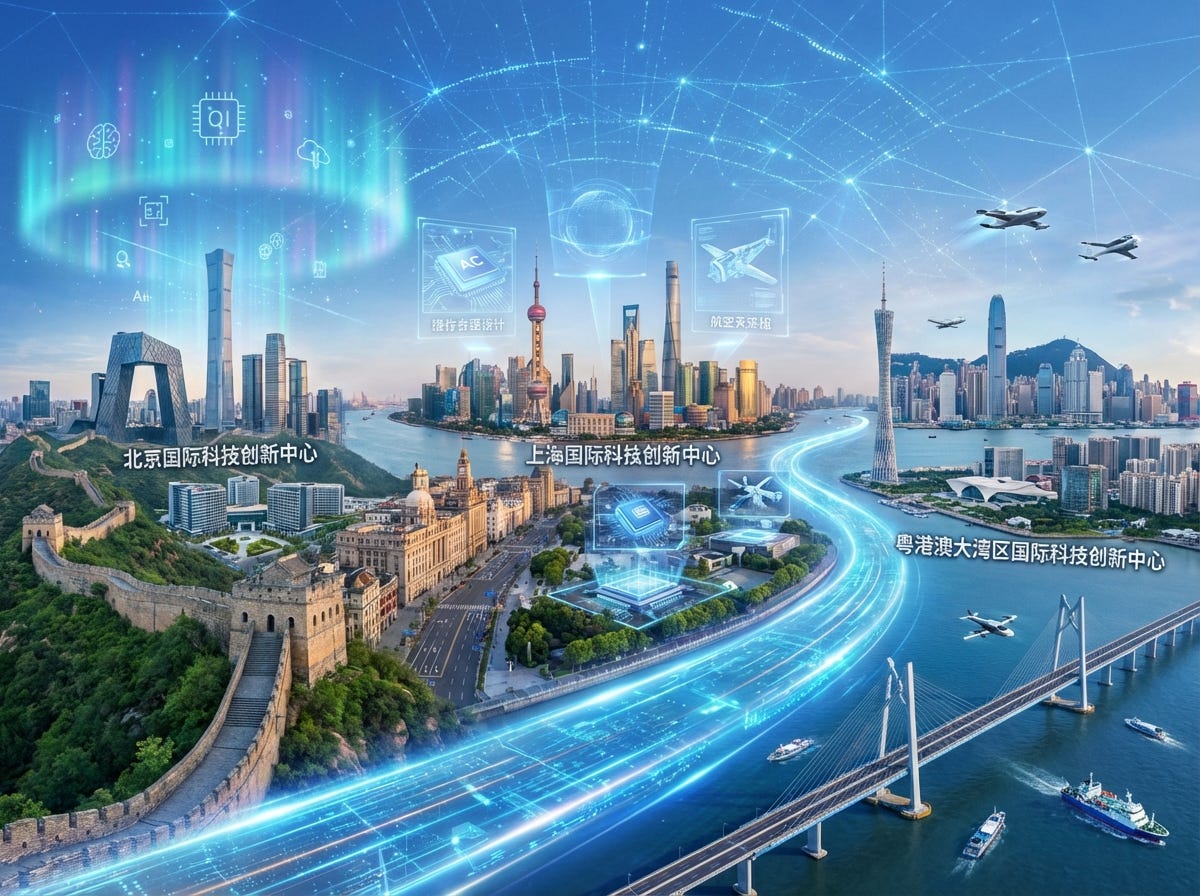
The era of “Made in China” as a singular, low-cost manufacturing label has officially passed. In its place, Beijing has architected a sophisticated “Innovation Troika”—a trio of regional engines designed to transform the country from a technology adopter into a global technology definer. For the international investor, the challenge is no longer just whether to be in China, but precisely where to sit within this new map of “New Quality Productive Forces.”
2026年,中国将高水平推进三大国际科技创新中心建设,加快建设区域科技创新中心,打造辐射带动区域高质量发展的创新增长极,因地制宜发展新质生产力。
0. The Industrial Mosaic: Mapping Sector Specialization
While all three hubs are racing toward “high-tech” supremacy, they are not running on the same track. Their industrial priorities are shaped by deep-seated regional legacies: Beijing is the architect of the future, Shanghai is the master of complex systems, and the GBA is the engine of the commercial frontier.
Beijing: Sovereignty through the “Deep & Future”
Beijing’s industrial strategy is an extension of its political identity. It focuses on the “Invisibles”—the foundational technologies that underwrite national security. The city has become the undisputed home for Quantum Information and Advanced AI Algorithms, where the goal isn’t just to build an app, but to own the underlying framework. Beyond the digital, Beijing has carved out a unique niche in Commercial Aerospace. At its “Rocket Street” in E-town, the focus is on satellite constellations and reusable launch vehicles, turning the city into a strategic terminal for the low-altitude economy. If an industry requires immense capital, decades of patience, and a “Black Swan” breakthrough, it is likely being built in Beijing.
Shanghai: The Bastion of Precision and Scale
Shanghai operates at the intersection of high-end manufacturing and global finance. Its specialization lies in Integrated Sovereignty, specifically the entire semiconductor lifecycle. While others design chips, Shanghai makes them, hosting the country’s most advanced fabrication plants. This “heavy lifting” extends to Biomanufacturing and Innovative Drugs, where Shanghai is moving away from generics toward original molecular discovery. The region also remains the heart of China’s Automotive and Aviation industries. Here, the focus is on the “Big Machines”—the C919 large aircraft and high-end New Energy Vehicles (NEVs) that require a vast, high-precision supply chain that only the Yangtze River Delta can provide.
Greater Bay Area: The Pulse of Hardware and Speed
The GBA’s industrial DNA is market-driven and ruthlessly efficient. It has transformed from the “world’s factory” into the “world’s laboratory for hardware.” Its focus is on Mass-Market High-Tech—think 5G/6G telecommunications, high-end consumer drones, and the next generation of Wearable IoT. While Beijing writes the code, the GBA builds the device. Recently, the region has pivoted aggressively toward the Low-Altitude Economy and Robotics, leveraging its dense network of electronics suppliers to iterate humanoid robots and eVTOL (electric vertical takeoff and landing) aircraft at a speed that baffles global competitors. In the GBA, an industry is only as good as its ability to scale and dominate the global shelf.
1. The National Brain: Beijing and the “0 to 1” Frontier
Beijing remains the undisputed center of gravity for fundamental research. This is where the country’s “chokepoint” technologies are being tackled in the laboratories of Zhongguancun and the sprawling “Science Cities” of Huairou and Changping.
While the “Three Science Cities” handle the theoretical breakthroughs, the Yizhuang Economic-Technological Development Area (E-town) has emerged as the critical “hands” for this “brain.” E-town is where quantum computing patents and AI algorithms meet high-end assembly lines. For investors, Beijing represents the “Deep Tech” play—it is high-risk, high-barrier, and deeply aligned with national security and sovereign self-reliance.
( 北京:中关村科学城、怀柔科学城、未来科学城和北京经济技术开发区,即“三城一区”)
北京提出,提升雄安新区中关村科技园发展能级,建设北京—雄安人才科创走廊。天津将做优科创服务生态,大力发展研究开发、概念验证、知识产权、企业孵化等业态,建设20个校企联合实验室,加快重点产业和领域中试平台建设。河北明确,建强用好燕赵系列实验室,聚焦重点产业突破一批关键核心技术。
2. The Industrial Backbone: Shanghai’s Integrated Sovereignty
If Beijing is the brain, Shanghai and the Yangtze River Delta form the central nervous system of Chinese industry. The focus here is “1 to 100”—taking a proven technology and integrating it into a massive, high-precision industrial ecosystem.
Through the Zhangjiang Science City and the Lin-gang Special Area, Shanghai has achieved a complete, end-to-end semiconductor supply chain. This makes Shanghai the premier destination for institutional capital seeking scale and “Patient Capital” opportunities in sectors like biopharma and commercial aviation.
在推进国际科技创新中心建设中,强化科产创新跨区域协同是三省一市(安徽、江苏、浙江+上海)的共同发力重点。
3. The Agile Accelerator: Rapid Iteration in the GBA
The Greater Bay Area (GBA) excels at “100 to N”—the rapid commercialization and global scaling of hardware. The GBA is a sprawling, interconnected workshop where a prototype can move from a sketch to a production run faster than anywhere else on earth.
With the Hetao Shenzhen-Hong Kong Innovation Zone (河套深港科技创新合作区)bridging the gap, the GBA offers a unique “Dual System” advantage. Investors can leverage Hong Kong’s common law and familiar financial architecture to access the raw manufacturing power of the mainland. This is the heart of the world’s consumer drone, IoT, and EV hardware sectors.
🌍 Global Benchmarks: Learning from the World’s Best
Recent analysis highlights that China’s three hubs are increasingly adopting “Global Best Practices” from established innovation clusters like Boston, Munich, and Singapore. This convergence provides a more predictable framework for international investors:
The “Boston Model” of Industry-Academia Fusion: Mirroring the success of MIT’s Technology Licensing Office, China’s hubs are bridging the “Valley of Death” between labs and markets. New policies are encouraging researchers to hold equity in startups, creating a “demand-oriented” R&D cycle similar to the AstraZeneca-London collaboration.
“Patient Capital” Infrastructure: Following the “Tolerance for Failure” culture of Silicon Valley and the long-term credit models of Munich, China is restructuring its state-guided funds. Investors are seeing a shift toward 8-12 year investment cycles, providing a stable capital buffer for high-stakes ventures like solid-state batteries and quantum networking.
The “Singapore/Paris” Open Ecosystem: To attract global talent, the three hubs are implementing “Tech Pass” style fast-track visas and tax incentives. By adopting international standards for Intellectual Property (IP) protection—where punitive damages are reaching global norms—China is attempting to build an environment where multinational R&D teams feel as secure as they do in Europe or Southeast Asia.
💡 Investor Insight: The Transfer Gap Alpha
For the global investment community, the primary opportunity lies in the deliberate friction between these three hubs. The real “Alpha” is often found in the Transfer Gap. As technologies move from Beijing’s labs to Shanghai’s integration centers, and finally to the GBA’s global export machines, there is a massive demand for specialized financial services, intellectual property brokerage, and cross-border legal consulting.
