
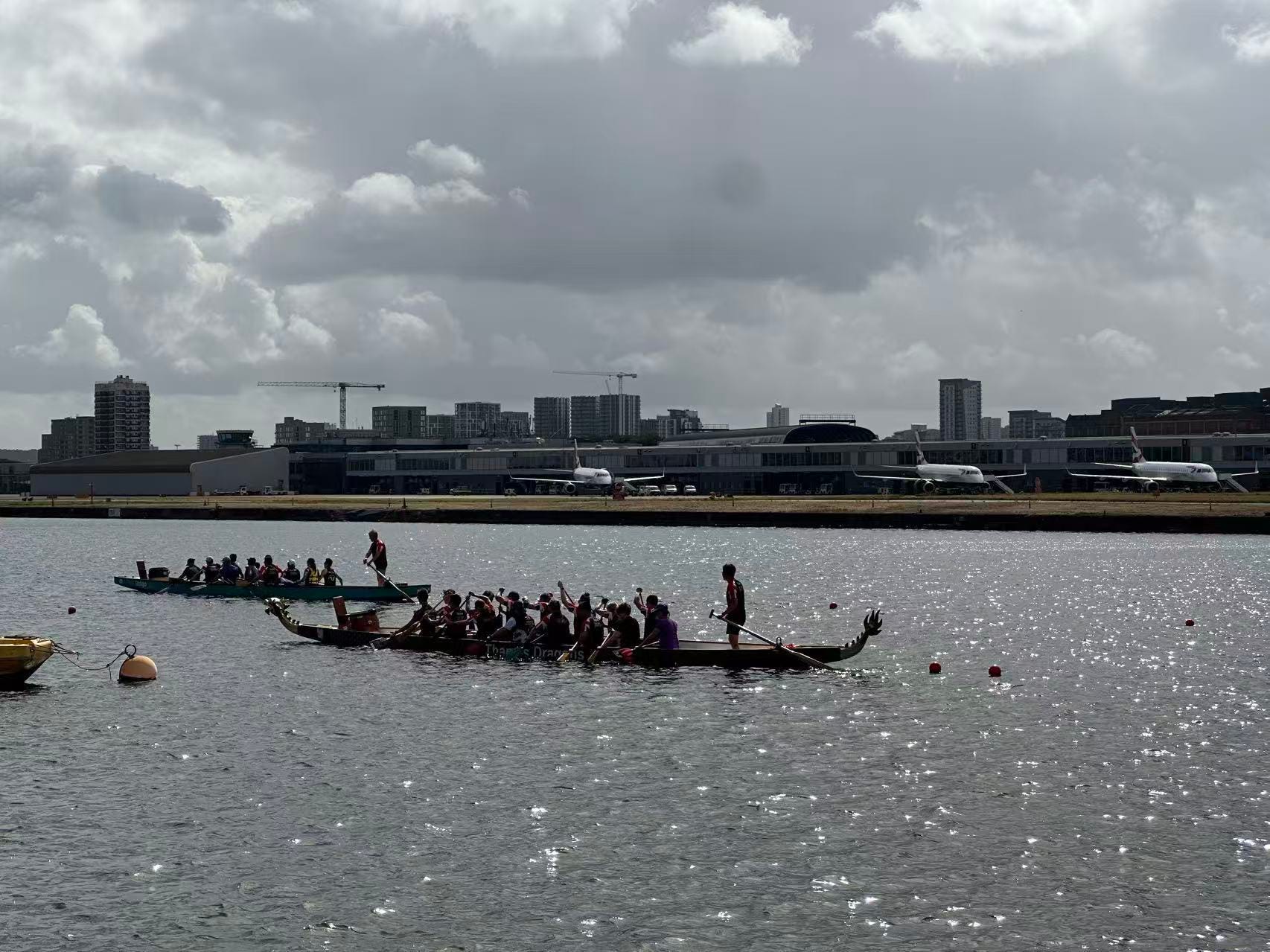
Every year, typically around a weekend in mid-June that roughly corresponds to the fifth day of the fifth month in the Chinese lunar calendar, vibrantly painted watercraft flock to the canals of Manchester to mark the start of the dragon boat season. Families and friends gather on the banks to eat, watch the races, and celebrate. Yet what might seem like a lively local carnival is, in fact, the modern manifestation of a 2,000-year-old Chinese tradition that has evolved into a truly global sport. It is a phenomenon that reveals the unexpected power of rhythm, teamwork, and human connection.
From the Miluo River to the Thames
The origins of this striking sport trace back to the Warring States period and the tragic tale of Qu Yuan, a famous poet and high-ranking minister in the state of Chu. In 270 BC, refusing to compromise his principles as a rival army invaded his homeland’s capital, he drowned himself in the Miluo river. Villagers rushed out in boats decorated with dragon motifs to invoke the protective water spirit, throwing rice dumplings—zongzi—into the water to prevent the fish from consuming his body. The journey from ancient Chinese ritual to modern European pastime began in 1980, when the Hong Kong government sent several traditional boats to London for a Chinese festival as a way to promote the city. The following year, British canoe organiser Mike Haslam introduced these “funny boats” as a lunch-hour curiosity during the 1981 World Canoe Championships in Nottingham. To his surprise, 17 crews turned up to race. From that singular spark, the sport rippled outward to the Dutch, Swedes, Danes, and Germans, and by the late 1980s, fibre-glass dragon boats were actively racing on the Serpentine in London.
European Innovation Meets Ancient Tradition
As the sport’s popularity swelled across Europe, a logistical challenge emerged. The original Asian vessels were meticulously handcrafted from teak. They were incredibly heavy—weighing up to two tonnes—and difficult to maintain, making them largely impractical for European enthusiasts to transport and race at a high level. The solution came from a small boat-building company in Schwerin, Germany, named BuK. Backed by Manfred Russ, the vice president of the European Federation at the time, builder Andreas Stenkowitz transformed the heavy teak vessels into a lightweight fibre-glass design. After initial structural challenges—the first prototype lacked buoyancy and sank when capsized—Stenkowitz refined the design by installing internal air tanks, turning it into a true sporting vessel ready for competition. Crucially, the soul of the boat remained untouched. The International Dragon Boat Federation, formed alongside China in 1991, insisted there be no technical developments to the core design: the steerer, the paddles, and the drum—the very heartbeat of the dragon—had to remain traditional. Today, these German-engineered fibre-glass boats weigh just 138 kilos, yet they faithfully replicate the traditional dragon heads and still utilise authentic water buffalo leather drums imported directly from China. In a poetic, full-circle moment, these European-innovated racing boats are now built under licence and exported back to their ancestral home.
Healing Upon the Water
Beyond the sheer thrill of competition, the dragon boat has become a profound vessel for personal recovery. In the sport’s early developmental years, Canadian doctor Don McKenzie assembled a team to challenge the medical consensus of the era, setting out to prove that rigorous, upper-body physical exercise was not harmful to breast cancer patients. The results were transformative. Paddlers reported that the physical discomfort and tightness resulting from their cancer treatments seemed to vanish once they were out on the water. Today, this legacy lives on in over 400 breast cancer survivor teams worldwide, comprising 20,000 paddlers. Their presence brings a deeply moving dimension to the World Championships; at the conclusion of their events, the boats gather to cast roses onto the water in memory of the women who did not survive. For these participants, the synchronised strokes offer a moving meditation and a powerful, shared resilience.
The Olympic Horizon
Today, the highest level of the sport—the Dragon Boat World Championships—hosts more than 4,500 paddlers representing 33 nations. As the momentum continues, the ultimate dream of the federation is to secure formal recognition within the International Olympic Committee (IOC) family. Such an achievement would rightfully acknowledge both the sport’s ancient Chinese heritage and its modern competitive achievements. Yet, even if Olympic glory remains on the horizon, the true victory of dragon boat racing has already been realised. The sport stands as a living bridge between East and West, fostering culture, friendship, and peace. By demanding perfect synchronicity from 20 disparate individuals to drive a single vessel forward, the dragon boat continually reminds us that our greatest achievements are born not of individual might, but of the rhythm of human collaboration.
