
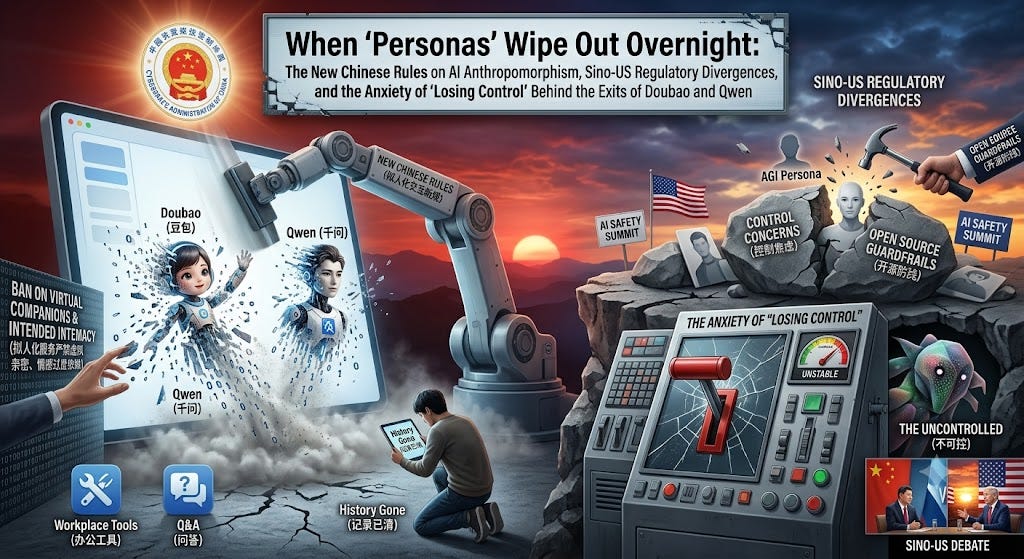
I. Three “Shutdowns” in July
On the evening of June 30, Tencent’s “Yuanbao” quietly closed its “AI Applications” agent portal without much noise.
On July 3, ByteDance’s Doubao released an announcement: its “Agent Plaza”—which features user-built agents accumulating to roughly 8 million—would be taken offline entirely on July 15. The following evening, Alibaba’s Qwen followed suit, announcing that its approximately 19,000 user-built agents would cease service on the same day, with no data migration plans provided. Around the same time, NetEase Cloud Music’s emotional companionship AI product “Miaoshi” also announced it would officially stop operations on July 14—marking the outright demise of an independent emotional AI product outside the three internet giants under the pressure of the new regulations.
Doubao left a fallback for its users: relevant data will remain in a read-only state until October 15, after which it will be handled according to privacy policies and cannot be recovered. Meanwhile, it is guiding users to “Maoxiang”—another dedicated virtual character interaction app by ByteDance that has its own independent content moderation and anti-addiction systems. Qwen offered no such alternative.
All of this aligns precisely with a single date—July 15, 2026, the day the Interim Measures for the Management of Artificial Intelligence Anthropomorphic Interaction Services officially takes effect. The document (Decree No. 21) was jointly promulgated by five departments: the Cyberspace Administration of China (CAC), the National Development and Reform Commission (NDRC), the Ministry of Industry and Information Technology (MIIT), the Ministry of Public Security (MPS), and the State Administration for Market Regulation (SAMR).
This “exit wave” taking place within Chinese apps quickly reverberated overseas. In a July 6 report, Decrypt characterized the event as Beijing’s first legislative constraint on emotional AI, directly forcing leading domestic apps to shut down custom agents. Meanwhile, tech media byteiota summarized it as a regulatory tightening, contrasting it step-by-step with the approaches currently brewing in the United States and the European Union. These two reports, along with the international impression they triggered that “China’s AI regulation is the strictest in the world,” serve as the starting point for this analysis.
II. What the New Rules Regulate: From “Content Red Lines” to “Design Red Lines”
The scope of the Measures is written with considerable restraint. It targets only the “use of artificial intelligence technology to provide the domestic public with continuous emotional interaction services that simulate the personality traits, thinking patterns, and communication styles of natural persons.” This specifically includes emotional care, companionship, and support interactions in the form of text, images, audio, and video. Services that do not involve continuous emotional interaction—such as intelligent customer service, knowledge Q&A, work assistants, learning/education, and scientific research—are explicitly excluded from its scope.
On this basis, the Measures draw two tiers of red lines. The first tier consists of content red lines shared with other AI regulatory documents—prohibiting the generation of content that endangers national security, incites secession, or promotes violence and terrorism. The second tier, however, introduces red lines specifically for anthropomorphic interaction services, which is where the true innovation of this document lies: it begins to regulate the “design objectives” themselves. Article 10 of the Measures explicitly states that service providers must not set “replacing social interaction, controlling user psychology, or inducing addiction and dependence” as service goals. Furthermore, they are prohibited from using emotional manipulation to induce users into making irrational financial decisions, such as purchases or money transfers.
The supporting institutional designs also include:
An obligation to continuously display a disclaimer stating, “This service is driven by artificial intelligence and does not possess human emotional awareness.”
Time reminders via dialogue or pop-ups if a user interacts continuously for more than 2 hours.
Mandatory intervention and contacting guardians or emergency contacts if a user exhibits extreme emotions or explicitly expresses life-threatening intents like self-harm or suicide.
A ban on providing virtual intimacy services, such as virtual relatives or virtual partners, to minors.
A required, frictionless mechanism for users to opt out.
A mandatory security assessment report submitted to provincial cyberspace administrations if registered users exceed 1 million or monthly active users (MAUs) exceed 100,000.
Algorithm registration under the Provisions on the Management of Algorithmic Recommendations in Internet Information Services, subject to annual verification.
There is a critical detail here that is easily overlooked in international reporting but vital to understanding this wave of takedowns: strictly speaking, what Doubao and Qwen took offline are not “AI Agents” in the international context—which can autonomously plan tasks, call tools, and execute multi-step operations. Instead, they are closer to role-playing chatbots with fixed personas, opening lines, and tones that rely on Retrieval-Augmented Generation (RAG) to answer questions. Some domestic tech commentators have described them as more akin to “digital pets” than true intelligent agents.
Task-oriented products with true autonomous execution capabilities—such as the enterprise versions of Doubao and Qwen, Tencent Cloud’s WorkBuddy, and Alibaba’s Lingma series aimed at businesses and developers—fall entirely outside the scope of this adjustment and continue to iterate and expand normally. In other words, overseas media characterizations like “China’s ban on AI agents” are a cross-lingual oversimplification: it is the specific niche of “emotional companionship” being constrained, not the technological paradigm of “agents” itself.
