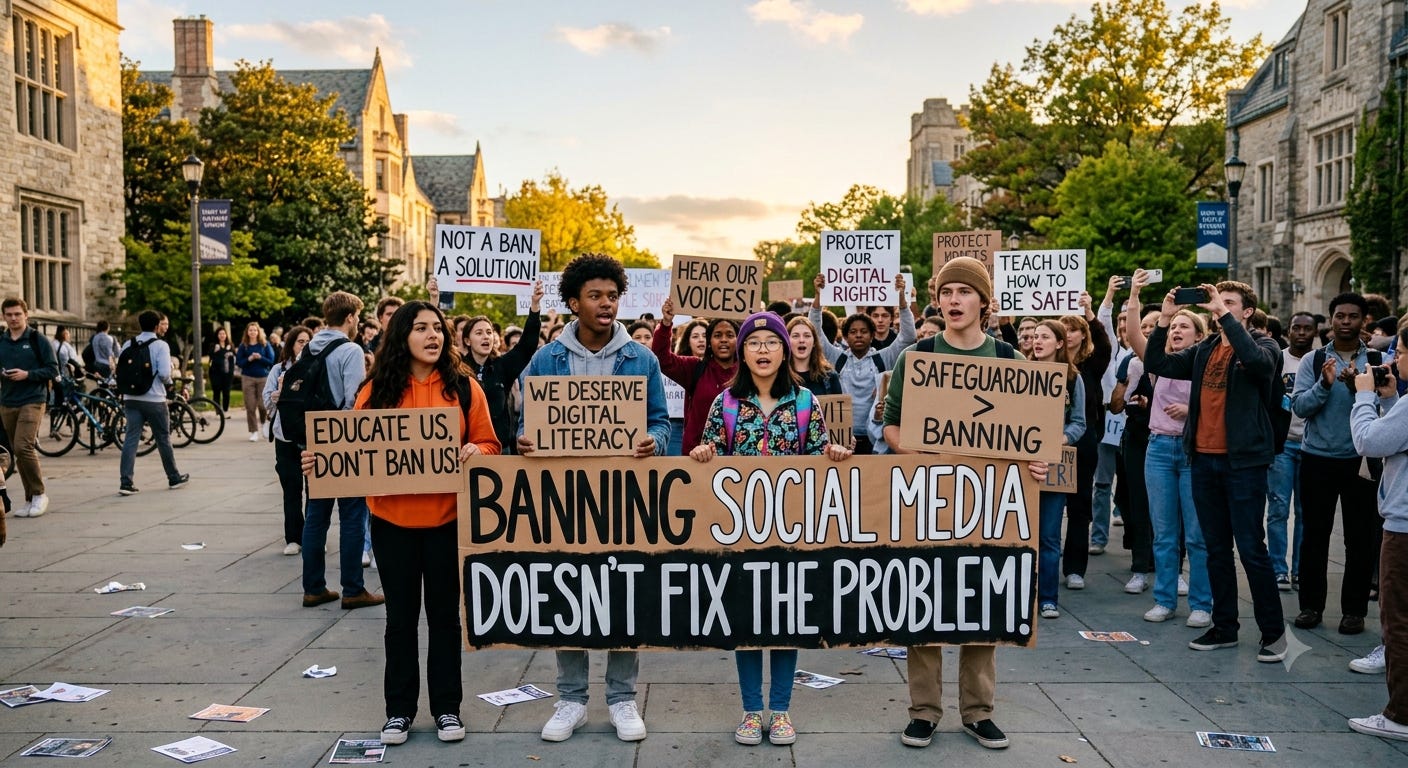
Youth Social Media Ban: Is It a Cure for the Root Cause?
On 15 June, the UK government officially announced that it would draw upon the Australian regulatory model to ban under-16s from using a range of social media applications. This heavyweight ban, aimed at protecting the physical and mental health of teenagers, explicitly categorises mainstream platforms such as Snapchat, TikTok, YouTube, Instagram, Facebook, and X as “restricted zones”, while daily instant messaging tools like WhatsApp and Signal remain temporarily exempt.
Regarding the hazards of social media, the UK Prime Minister Keir Starmer—who had not yet resigned at the time—pointed out at the press conference that social media not only exposes teenagers to bullying and harassment but that its very design, engineered to be “addictive”, is inherently dangerous. According to the plan published by the UK government, alongside implementing age blocks at the platform level, the new regulations will also take measures to prevent strangers from contacting minors on gaming or live-streaming platforms. Furthermore, some regulations will extend to 16- and 17-year-olds to avoid a “cliff-edge” drop in protection when children turn 16. The UK government stated that specific measures will be announced in July, with full implementation expected by the spring of 2027.
During the initial consultation stage, the UK government received over 116,000 responses from parents, industry professionals, and young people. The data revealed an overwhelming public consensus: over 83% of surveyed parents believe the risks of social media far outweigh the benefits, and a staggering 90% support raising the minimum age for accessing these platforms to 16.
“Laws are rules, but they are also an expression of values... It will make our children safer and happier. It will afford them more time, more security, more freedom to grow, and more opportunities.” Anticipating criticisms about the technical enforceability of the ban, the Prime Minister candidly admitted that the legislation would not eliminate underage usage overnight. He also drew a sharp parallel between the social media ban and the prohibition of alcohol sales to minors: “Look a teenager managed to get a drink somehow… So let’s not bother banning alcohol sales to children. We don’t do that do we? That would be utterly ridiculous.”
The Sweeping Global Regulatory Wave and the Question of a “Cure”
The UK is not walking this path alone. Since late last year, a wave of regulation targeting the digital boundaries of minors has swept the globe. Over ten countries, including Australia, Malaysia, Indonesia, Spain, Greece, Denmark, and France, have introduced or advanced social media bans for minors. Their core objective is highly consistent: to protect children from the risks of cyberbullying, addiction, and an escalating mental health crisis.
On 10 December 2025, Australia’s social media ban for under-16s officially came into effect, triggering a widespread demonstration effect globally. Different countries have adopted varying approaches: some (such as France and certain states in the US) hand the authority over young minors’ internet access to their parents; some (such as the Netherlands and Italy) have completely banned electronic products on primary and secondary school campuses; while a third category, including Australia, Indonesia, and the UK, relies on legislation to implement blanket bans on under-16s using most social media platforms.
However, in the six months since Australia’s ban was implemented, the initial results have fallen short of expectations. Minors can easily bypass the restrictions to register new accounts and continue using social media through technical workarounds or by misreporting their age, rendering the ban virtually ineffective. Zichen Hu, an Research Associate at Oxford Global Society, noted that while the Australian experience holds vital reference value for the UK, whether the ban can truly work in the UK will similarly depend on the vigour of policy enforcement, the platform designs of tech companies, and the comprehensiveness of social support systems beyond the ban itself.
From Draft to Reality: The Balance Between Five Stakeholders
Can such a ban truly “cure the root cause”?
To answer this, we must return to where the ban originated. When many people in the UK think of teenagers, their immediate reaction is one of trouble, threat, or even anti-social behaviour. This phenomenon is termed “Ephebiphobia” (the fear or loathing of adolescents) by British sociologists. I, too, was once harassed and attacked by a group of teenagers on the Central line of London Underground during the COVID-19 pandemic. Due to aging station infrastructure and a lack of effective surveillance equipment, reporting the incident to the police yielded no results. According to a 2024 survey of nearly 8,000 children by HM Inspectorate of Probation, nearly 25% of respondents had committed violence or been victims of it, and nearly half claimed to have witnessed violence in 2023. British police have found that a large number of street knife crimes involving youth often stem from petty arguments that escalated online.
The problems brought by social media extend beyond violence. Another high-profile news story from February 2024 detailed how a 12-year-old Italian girl underwent a drastic personality shift within just a few months due to continuous exposure to content related to depression and self-harm pushed by social media algorithms, ultimately leading to her tragic suicide.
Discussions surrounding social media regulation in Europe have never ceased. The new ban brings to mind the consultation period for the UK’s Online Safety Bill draft a few years ago. At that time, my supervisor, Professor Damian Tambini—a media governance and regulation expert at the London School of Economics (LSE)—guided the faculty and students to dissect the pros and cons of the bill from every angle. He collated multiple opinions and formally submitted legislative advice to the UK Parliament. As a veteran media regulation expert, he has been deeply involved in policymaking for the UK’s communications regulator (Ofcom) and various European media regulatory committees. During those discussions, one of the most central and contentious propositions was how to strike a balance between “protecting citizens’ freedom of speech” and “safeguarding minors”. Clearly, a crude, blanket ban is by no means the most subtle solution.
To understand this complex landscape, apart from the familiar necessity of protecting teenagers, we must also examine other factors involving five core players.
1. Teenagers: Stripped of Freedom or Pushed into the Shadows?
First in the line of fire are the subjects of the ban: teenagers. For them, social media is not merely a pastime; it is a “digital public square” for accessing information, building social circles, and understanding the world. A BBC report astutely highlighted a glaring irony that might emerge in British society once the ban takes effect: a 16-year-old Briton can legally consent to sex, join the armed forces, marry in certain regions, and even cast a sacred vote in some elections—yet they are legally barred from browsing social media. Furthermore, bans often breed rebellion. Around the time the UK’s Online Safety Act took effect, internet searches for VPNs surged. When the main gates are bolted, tech-savvy teenagers are highly likely to pivot to encrypted apps or unregulated dark web corners, effectively removing them from the protective gaze of the public eye. Leyi Shao, an 18-year-old youth living in London, expressed that she and her classmates do not entirely support this social ban because they are “concerned that it removes a significant degree of autonomy from teenagers.”
2. Parents: How to Fill the Screen-Time Vacuum?
Official UK surveys show that 90% of parents support the ban, reflecting the profound anxiety of modern families in the digital age. However, does confiscating a child’s phone and stripping away social media time naturally equate to parents providing higher-quality companionship and education? If the ban takes effect and children suddenly find themselves with vast amounts of free time, what will society and families use to replace the stimulation and connection previously offered by the virtual world? If parents continue to blindly scroll through their phones at the dinner table whilst forcefully demanding their children stay away from screens, such double standards are destined to fail in delivering the “better, more fulfilling childhood” Starmer spoke of.
3. Tech Platforms: The Original Sin of Algorithms and “Digital Labour”
Starmer noted that tech giants deliberately engineer “addictive” mechanisms—like infinite scrolling and hyper-targeted recommendations—to harvest user attention. Social media platforms acquire users’ private information by offering free content, and then reap massive profits by selling “precision advertising” to marketers. On one hand, users become hooked; on the other hand, the “creative labour” provided by content creators receives only a disproportionately small share of the revenue distributed by the platforms. In this ecosystem, platforms hold absolute power and the lion’s share of profits. True regulation should not merely be an age block; it must constrain algorithmic mechanisms at the source and re-evaluate the equitable distribution of digital labour rights.
4. Society and Schools: The “Sex Education” Revelation for Digital Literacy
Faced with a pervasive digital world, schools and society bear an undeniable educational responsibility. On this issue, the cultivation of digital literacy should draw upon the logic of modern “sex education”. We would never completely avoid the topic of sex before a child turns 16 simply because it carries potential risks, expecting them to suddenly acquire the ability to navigate complex relationships on their 16th birthday. By the same token, building digital literacy must be a gradual, step-by-step process. Society needs to teach children how to identify misinformation, how to protect personal privacy, and how to combat algorithmic echo chambers. Blind concealment and isolation will only create “giant infants” of the digital age, entirely ill-equipped to handle the real world.
5. Government Regulation: Protectionism or Overreaching Surveillance?
Finally, when playing the role of “ protector”, the government must be extremely wary of overstepping its bounds. Does completely banning under-16s from accessing social media infringe, to some extent, upon the fundamental digital human rights of children to access information, as enshrined in the UN Convention on the Rights of the Child? As multiple countries advance social media bans, “how to verify user age” has become the greatest technical bottleneck in implementing these policies. To achieve the “hard barriers that truly work” that Starmer mentioned, platforms are highly likely to resort to demanding government IDs, credit card scans, or forcing the use of biometric technologies like facial recognition. If sensitive data is leaked, would this pose a whole new threat to child safety?
The Way Forward: The “Sex Education” Revelation for Digital Media Literacy
Faced with a pervasive digital world that is growing increasingly sophisticated with the backing of Artificial Intelligence (AI), rigid blockades can only build a fragile sterile room. The true path to breaking the siege lies in systematically embedding the cultivation of “digital and AI literacy” and critical thinking into the curricula of primary and secondary schools and communities.
In this regard, the establishment of digital literacy should draw upon the scientific logic of modern “sex education”. We would never completely avoid the topic of sex or treat it as a taboo before a child comes of age simply because it might carry risks or harm, expecting them to suddenly figure it out on their own the day the restrictions are lifted. By the same token, the traffic rules of the digital world need to be taught step by step.
Students need to be taught how platform algorithms manipulate their visual focus via dopamine mechanisms, how to use multi-source verification to pierce through AI-generated deepfakes and misinformation, and how to set up digital defence lines to protect their privacy. Only by shifting the educational focus from “what you are not allowed to see” to “how to view what you see” can we build a lifelong immunity in children to cope with the digital tide.
Families, Schools, and Society Weaving a Safety Net Together
The “cultural shift” Starmer hopes for is grand, but achieving its purpose cannot merely rely on a cold ban. Instead, it requires the five “players”—the government, platforms, society, parents, and individuals—to forge a new, warm social contract based on mutual care:
The Government needs to learn to “ease restrictions and increase investment”, investing heavily in offline infrastructure such as youth centres.
Platforms need to voluntarily relinquish the extraction of traffic and advertising revenue from teenagers through state regulation or self-regulation, thereby putting Corporate Social Responsibility (CSR) into genuine practice.
Parents can dilute dependence on the virtual world with high-quality family companionship.
Schools, serving as the primary battleground for digital literacy, must cultivate teenagers’ digital media literacy, whilst paying close attention to providing more grassroots offline psychological and community support for vulnerable youths in remote areas or marginalised groups.
Individuals must also learn “digital introspection”. This generation of children, known as the “screen generation”, actually possesses unprecedented self-awareness. Through the combined guidance of all parties, when teenagers begin to realise that “my time and energy should not be manipulated by the capital algorithms of tech companies”, they will learn to master the tools independently, rather than being reduced to slaves of the tools.
In the initial stages of policymaking, a blanket ban undoubtedly serves to sound society’s alarm, significantly awakening public scrutiny over the backlash of technology. However, this battle for the future cannot ultimately be won behind a closed, high wall. Only when all stakeholders pivot from “simply banning everything” to “weaving a safety net with care and synergy” can our children find their true point of balance between freedom and safety, and between a fulfilling childhood in reality and the digital society of the future.

